How Many Ounces in a Pound for Baby Weight
| pound | |
|---|---|
| Unit arrangement | British imperial, Us customary |
| Unit of | mass |
| Symbol | lb |
| Conversions | |
| 1 lb in ... | ... is equal to ... |
| SI units | 0.45359237 kg |
| Avoirdupois organization | 16 ounces |
The pound or pound-mass is a unit of mass used in British imperial and United States customary systems of measurement. Various definitions have been used; the near common today is the international avoirdupois pound, which is legally defined as exactly 0.453592 37 kilograms, and which is divided into xvi avoirdupois ounces.[1] The international standard symbol for the avoirdupois pound is lb;[2] an alternative symbol is lbm [3] (for most pound definitions), # (chiefly in the U.Southward.),[four] and ℔ [5] or ″̶ [half-dozen](specifically for the apothecaries' pound).
The unit is descended from the Roman libra (hence the abbreviation "lb"). The English discussion pound is cognate with, amongst others, German Pfund , Dutch pond , and Swedish pund . These units are historic and are no longer used (replaced past the metric system).
Usage of the unqualified term pound reflects the historical conflation of mass and weight. This accounts for the modern distinguishing terms pound-mass and pound-forcefulness.
Etymology [edit]
The word 'pound' and its cognates ultimately derive from a borrowing into Proto-Germanic of the Latin expression libra pondo ("the weight measured in libra "), in which the word pondo is the ablative atypical of the Latin noun pondus ("weight").[7]
Current utilize [edit]
The U.s. and countries of the Commonwealth of Nations agreed upon common definitions for the pound and the yard. Since i July 1959, the international avoirdupois pound (symbol lb) has been defined as exactly 0.453592 37 kg.[8] [9]
In the U.k., the use of the international pound was implemented in the Weights and Measures Human action 1963.[10]
The yard or the metre shall be the unit of length and the pound or the kilogram shall be the unit of measurement of mass by reference to which whatever measurement involving a measurement of length or mass shall be made in the United kingdom; and-
(a) the yard shall be 0.9144 metre exactly;
(b) the pound shall exist 0.453592 37 kilogram exactly.— Weights and Measures Act, 1963, Section ane(ane)[11]
An avoirdupois pound is equal to 16 avoirdupois ounces and to exactly 7,000 grains. The conversion factor between the kilogram and the international pound was therefore chosen to be divisible past seven with a terminating decimal representation, and an (international) grain is thus equal to exactly 64.79891 milligrams.
In the UK, the process of metrication and European units of measurement directives were expected to eliminate the use of the pound and ounce, just in 2007 the European Commission abandoned the requirement for metric-only labelling on packaged goods there, and allowed for dual metric–imperial mark to proceed indefinitely.[12] [13] When used as a measurement of torso weight, common UK practice exterior medical settings remains to use the stone of fourteen pounds as the chief measure e.one thousand. "11 stone 4 pounds", rather than "158 pounds" (equally done in the United states),[14] or "72 kilograms" as used elsewhere.
In the United States, the Metric Conversion Act of 1975 alleged the metric system to exist the "preferred system of weights and measures" merely did not suspend apply of The states customary units, and the United States is the only industrialised land where commercial activities do not predominantly utilise the metric system,[fifteen] despite many efforts to do and so, and the pound remains widely used equally i of the cardinal customary units.[16] [17]
Historic use [edit]

Comparison of the relative sizes of avoirdupois, troy, Tower, merchant and London pounds.
Historically, in different parts of the world, at unlike points in time, and for different applications, the pound (or its translation) has referred to broadly similar but not identical standards of mass or force.[eighteen]
Roman libra [edit]
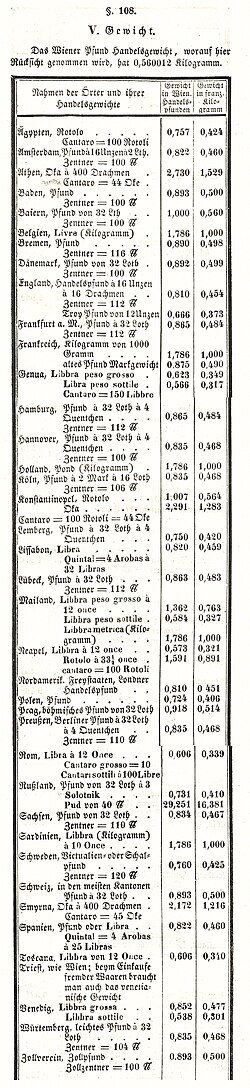
Diverse historic pounds from a German textbook dated 1848
The libra (Latin for "scales / balance") is an ancient Roman unit of mass that was equivalent to approximately 328.9 grams.[19] [xx] [21] It was divided into 12 unciae (atypical: uncia), or ounces. The libra is the origin of the abridgement for pound, "lb".
In Britain [edit]
A number of unlike definitions of the pound have historically been used in Britain. Amongst these were the avoirdupois pound and the obsolete Tower, merchant's and London pounds.[22] Troy pounds and ounces remain in use only for the weight of certain precious metals, especially in the merchandise; these are normally quoted just in ounces (e.one thousand. "500 ounces") and, when the type of ounce is not explicitly stated, the troy arrangement is assumed.
Historically, the pound sterling was a Tower pound of silver.[ commendation needed ] In 1528, the standard was changed to the Troy pound.[ citation needed ]
| Unit | Pounds | Ounces | Grains | Metric | |||||||||||||||||
|---|---|---|---|---|---|---|---|---|---|---|---|---|---|---|---|---|---|---|---|---|---|
| Avdp. | Troy | Belfry | Merchant | London | Metric | Avdp. | Troy | Tower | Troy | Tower | chiliad | kg | |||||||||
| Avoirdupois | 1 | 175 / 144 | = one.21527 | 35 / 27 | = i.296 | 28 / 27 | = 1.037 | 35 / 36 | = 0.972 | ≈ 0.9072 | 16 | xiv+ 7 / 12 | = 14.583 | 15+ 5 / 9 | = 15.five | 7000 | 0 9955+ 5 / 9 | ≈ 454 | ≈ 5 / xi | ||
| Troy | 144 / 175 | ≈ 0.8229 | 1 | 16 / 15 | = ane.0half dozen | 64 / 75 | = 0.853 | 4 / 5 | = 0.viii | ≈ 0.7465 | 13+ 29 / 175 | ≈ 13.17 | 12 | 12+ 4 / 5 | = 12.viii | 5760 | 08192 | ≈ 373 | ≈ 3 / 8 | ||
| Tower | 27 / 35 | ≈ 0.7714 | 15 / 16 | = 0.9375 | 1 | 4 / 5 | = 0.eight | 3 / four | = 0.75 | ≈ 0.6998 | 12+ 12 / 35 | ≈ 12.34 | 11+ 1 / iv | = 11.25 | 12 | 5400 | 07680 | ≈ 350 | ≈ seven / 20 | ||
| Merchant | 27 / 28 | ≈ 0.9643 | 75 / 64 | = ane.171875 | 5 / 4 | = 1.25 | ane | 15 / 16 | = 0.9375 | ≈ 0.8748 | 15+ 3 / 7 | ≈ fifteen.43 | 14+ 1 / 16 | = xiv.0625 | xv | 6750 | 09600 | ≈ 437 | ≈ 7 / 16 | ||
| London | 36 / 35 | ≈ ane.029 | five / 4 | = i.25 | 4 / 3 | = 1.iii | 16 / 15 | = i.0six | 1 | ≈ 0.9331 | 16+ sixteen / 35 | ≈ sixteen.46 | 15 | 16 | 7200 | 10240 | ≈ 467 | ≈ vii / fifteen | |||
| Metric | ≈ 1.1023 | ≈ ane.3396 | ≈ one.4289 | ≈ 1.1431 | ≈ 1.0717 | ane | ≈ 17.64 | ≈ sixteen.08 | ≈ 17.fifteen | 7716 | 10974 | = 500 | = i / ii | ||||||||
Avoirdupois pound [edit]
The avoirdupois pound, also known every bit the wool pound, first came into general utilise c. 1300. It was initially equal to 6992 troy grains. The pound avoirdupois was divided into 16 ounces. During the reign of Queen Elizabeth, the avoirdupois pound was redefined as 7,000 troy grains. Since then, the grain has often been an integral part of the avoirdupois system. By 1758, two Elizabethan Exchequer standard weights for the avoirdupois pound existed, and when measured in troy grains they were found to be of 7,002 grains and 6,999 grains.[23] [24] [a]
Imperial Standard Pound [edit]
In the United Kingdom, weights and measures have been defined by a long series of Acts of Parliament, the intention of which has been to regulate the sale of commodities. Materials traded in the marketplace are quantified according to accepted units and standards in order to avoid fraud. The standards themselves are legally defined so as to facilitate the resolution of disputes brought to the courts; merely legally defined measures will be recognised by the courts. Quantifying devices used by traders (weights, weighing machines, containers of volumes, measures of length) are subject area to official inspection, and penalties apply if they are fraudulent.
The Weights and Measures Act 1878 marked a major overhaul of the British organisation of weights and measures, and the definition of the pound given in that location remained in force until the 1960s. The pound was defined thus (Section iv) "The ... platinum weight ... deposited in the Standards department of the Board of Trade ... shall continue to exist the imperial standard of ... weight ... and the said platinum weight shall continue to be the Imperial Standard for determining the Regal Standard Pound for the United Kingdom". Paragraph xiii states that the weight in vacuo of this standard shall be called the Royal Standard Pound, and that all other weights mentioned in the act and permissible for commerce shall be ascertained from it alone. The First Schedule of the Act gave more than details of the standard pound: it is a platinum cylinder nearly i.35 inches (34 mm) high, and 1.15 inches (29 mm) bore, and the edges are carefully rounded off. It has a groove about 0.34 inches (8.6 mm) from the tiptop, to allow the cylinder to be lifted using an ivory fork. It was constructed following the destruction of the Houses of Parliament by fire in 1834, and is stamped P.Southward. 1844, 1 lb (P.S. stands for "Parliamentary Standard").
The pound was redefined in the United Kingdom past the Weights and Measures Act 1963 every bit a fraction of the standard kilogram: "the pound shall be 0.453 592 37 kilogramme exactly".[xi]
Relationship to the kilogram [edit]
The 1878 Act said that contracts worded in terms of metric units would be deemed by the courts to exist made according to the Purple units divers in the Act, and a table of metric equivalents was supplied and then that the Imperial equivalents could be legally calculated. This defined, in Britain police force, metric units in terms of Imperial ones. The equivalence for the pound was given every bit 1 lb = 453.59265 g or 0.45359 kg, which fabricated the kilogram equivalent to about 2.2046213 lb. In 1883, it was determined jointly past the Standards Department of the Lath of Merchandise and the Agency International that 0.453592 4277 kg was a improve approximation, and this figure, rounded to 0.453592 43 kg was given legal status by an Club in Council in May 1898.[25]
Nonetheless, in 1963, a new Weights and Measures Human action reversed this relationship and the pound was divers for the showtime time every bit a mass equal to 0.453592 37 kg to match the definition of the international pound agreed in 1959.[eleven]
Troy pound [edit]
A troy pound (abbreviated lb t[26]) is equal to 12 troy ounces and to 5,760 grains, that is exactly 373.2417216 grams.[27] Troy weights were used in England by jewellers. Apothecaries as well used the troy pound and ounce, merely added the drachms and scruples unit in the Apothecaries' system of weights.
Troy weight may accept its name from the French marketplace town of Troyes in France where English merchants traded at to the lowest degree as early as the early 9th century.[28]
The troy pound is no longer in general use or a legal unit for trade (it was abolished in the United kingdom of great britain and northern ireland on vi January 1879 by the Weights and Measures Act of 1878), simply the troy ounce, ane⁄12 of a troy pound, is all the same used for measurements of gems such as opals, and precious metals such as silver, platinum and particularly gold.[29]
Tower pound [edit]

The system called Belfry weight was the more general name for King Offa's pound. This dates to 757 Advertisement and was based on the silver penny.[ citation needed ]
The Tower pound was also called the Moneyers' Pound (referring to the Saxon moneyers earlier the Conquest),[thirty] the easterling pound, which may refer to traders of eastern Germany, or to traders on the shore of the eastern Baltic bounding main, or dealers of Asiatic appurtenances who settled at the Steelyard wharf;[31] and the Rochelle Pound by French writers, because it was besides in utilise at Rochelle.[32] An almost identical weight was employed by the Germans for weighing aureate and silver.
The mercantile pound (1304) of 6750 troy grains, or 9600 Tower grains, derives from this pound, equally 25 shilling-weights or 15 Tower ounces, for full general commercial use. Multiple pounds based on the same ounce were quite common. In much of Europe, the apothecaries' and commercial pounds were different numbers of the same ounce.[ citation needed ]
The Tower organization was referenced to a standard prototype constitute in the Tower of London and ran concurrently with the avoirdupois and troy systems until the reign of Henry VIII, when a purple proclamation dated 1526 required that the troy pound to be used for mint purposes instead of the Tower pound.[33] No standards of the Tower pound are known to have survived.[34]
The Tower pound was equivalent to nearly 350 grams.[35] [36]
| ane mercantile pound (15 oz) | = | nine,600 Tower grains | = | 6,750 troy grains |
| ane Tower pound (12 oz) | = | seven,680 Tower grains | = | 5,400 troy grains |
| 1 Belfry ounce (20 dwt) | = | 640 Tower grains | = | 450 troy grains |
| 1 Tower pennyweight (dwt) | = | 32 Belfry grains | = | 22+ 1⁄two troy grains |
Merchants' pound [edit]
The merchants' pound (mercantile pound, libra mercantoria , or commercial pound) was considered to exist equanimous of 25 rather than 20 Tower shillings of 12 pence.[37] It was equal to 9,600 wheat grains (15 tower ounces or 6,750 grains)[28] and was used in England until the 14th century[28] for appurtenances other than money and medicine ("electuaries").[37]
London pound [edit]
The London pound is that of the Hansa, as used in their various trading places. The London pound is based on 16 ounces, each ounce divided every bit the tower ounce. Information technology never became a legal standard in England; the utilize of this pound waxed and waned with the influence of the Hansa itself.
A London pound was equal to seven,200 troy grains (16 troy ounces) or, equivalently, 10,240 belfry grains (16 tower ounces).
| 1 London pound (sixteen oz) | = | one+ 1⁄3 tower pounds (one.25 Troy pounds) | = | x,240 tower grains | = | seven,200 troy grains |
| i London ounce (20 dwt) | = | 1 tower (or troy) ounce | = | 640 tower grains | = | 450 troy grains |
| 1 London pennyweight | = | 1 tower (or troy) pennyweight | = | 32 tower grains | = | 22+ ane⁄2 troy grains |
In the United States [edit]
In the United States, the avoirdupois pound as a unit of mass has been officially defined in terms of the kilogram since the Mendenhall Guild of 1893. That order defined the pound to exist two.20462 pounds to a kilogram. The following year, this relationship was refined as two.204622 34 pounds to a kilogram, post-obit a determination of the British pound.[25]
In 1959, the United States National Bureau of Standards redefined the pound (avoirdupois) to be exactly equal to 0.453 592 37 kilograms, as had been declared past the International Yard and Pound Agreement of that year. Co-ordinate to a 1959 NIST publication, the Us 1894 pound differed from the international pound by approximately one part in 10 meg.[1] The difference is so insignificant that it can be ignored for almost all practical purposes.[38]
Byzantine litra [edit]
The Byzantines used a series of measurements known as pounds (Latin: libra, Aboriginal Greek: λίτρα, romanized: litra ). The most common was the logarikē litra ( λογαρική λίτρα , "pound of account"), established by Constantine the Great in 309/310. It formed the basis of the Byzantine monetary system, with one litra of gold equivalent to 72 solidi . A hundred litrai were known as a kentēnarion ( κεντηνάριον , "hundredweight"). Its weight seems to accept decreased gradually from the original 324 grams to 319. Due to its association with gold, information technology was besides known as the chrysaphikē litra ( χρυσαφική λίτρα , "gold pound") or thalassia litra ( θαλάσσια λίτρα , "maritime pound"), just it could also be used as a measure of country, equalling a fortieth of the thalassios modios .[39]
The soualia litra was specifically used for weighing olive oil or woods, and corresponded to 4/five of the logarikē , i.e. 256 1000. Some outlying regions, especially in later times, adopted diverse local measures, based on Italian, Arab or Turkish measures. The almost important of these was the argyrikē litra ( αργυρική λίτρα , "silverish pound") of 333 g, found in Trebizond and Cyprus, and probably of Arab origin.[39]
French livre [edit]
Since the Middle Ages, diverse pounds (livre) have been used in France. Since the 19th century, a livre has referred to the metric pound, 500g.
The livre esterlin was equivalent to about 367.one grams (5,665 gr) and was used betwixt the tardily 9th century and the mid-14th century.[40]
The livre poids de marc or livre de Paris was equivalent to almost 489.v grams (7,554 gr) and was used between the 1350s and the tardily 18th century.[forty] It was introduced by the regime of John 2.
The livre métrique was set equal to the kilogram by the decree of 13 Brumaire an IX between 1800 and 1812. This was a form of official metric pound.[40]
The livre usuelle (customary unit) was defined every bit 500 grams by the decree of 28 March 1812. It was abolished as a unit of mass effective i January 1840 past a decree of iv July 1837,[40] only is withal used informally.[ citation needed ]
German language and Austrian Pfund [edit]
Originally derived from the Roman libra, the definition varied throughout the Holy Roman Empire in the Middle Ages and onward. For case, the measures and weights of the Habsburg monarchy were reformed in 1761 by Empress Maria Theresia of Republic of austria.[41] The unusually heavy Habsburg (civil) pound of 16 ounces was later on divers in terms of 560.012 grams. Bavarian reforms in 1809 and 1811 adopted essentially the same standard as the Austrian pound. In Prussia, a reform in 1816 defined a uniform civil pound in terms of the Prussian pes and distilled water, resulting in a Prussian pound of 467.711 grams.
Betwixt 1803 and 1815, all German language regions west of the River Rhine were under French command, organised in the departements: Roer, Sarre, Rhin-et-Moselle, and Mont-Tonnerre. As a event of the Congress of Vienna, these regions once more became part of diverse High german states. Nonetheless, many of these regions retained the metric system and adopted a metric pound of precisely 500 grams. In 1854, the pound of 500 grams likewise became the official mass standard of the German Customs Marriage, but local pounds continued to co-exist with the Zollverein pound for some time in some German states. Present, the term Pfund is sometimes still in use and universally refers to a pound of 500 grams.[ commendation needed ]
Russian funt [edit]
The Russian pound (Фунт, funt) is an obsolete Russian unit of measurement of measurement of mass. It is equal to 409.51718 grams.[42] In 1899, the funt was the basic unit of weight, and all other units of weight were formed from it; in item, a zolotnik was one/96 of a funt, and a pood was twoscore funts.
Skålpund [edit]
The Skålpund was a Scandinavian measurement that varied in weight between regions. From the 17th century onward, information technology was equal to 425.076 grams in Sweden but was abandoned in 1889 when Sweden switched to the metric organisation.
In Kingdom of norway, the same name was used for a weight of 498.ane grams. In Denmark, information technology equalled 471 grams.
In the 19th century, Denmark followed Germany's lead and redefined the pound as 500 grams.
Portuguese libra and arrátel [edit]
The Portuguese unit that corresponds to the pounds of unlike nations is the arratel, equivalent to 16 ounces of Colonha, a variant of the Cologne standard. This arratel was introduced in 1499 by Manuel I, king of Portugal. Based on an evaluation of bronze nesting weight piles distributed by Manuel I to different towns, the arrátel of Manuel I has been estimated to be of 457.8 g. In the early on 19th century, the arratel was evaluated at 459 g.[43]
In the 15th century, the arratel was of 14 ounces of Colonha or 400.vi 1000. The Portuguese libra was the same as two arrátels. In that location were also arratels of 12.5 and thirteen ounces and libras of 15 and 16 ounces. The Troyes or Tria standard was also used.[44]
Jersey pound [edit]
A Bailiwick of jersey pound is an obsolete unit of mass used on the isle of Jersey from the 14th century to the 19th century. Information technology was equivalent to almost 7,561 grains (490 grams). Information technology may have been derived from the French livre poids de marc.[45]
Trone pound [edit]
The trone pound is one of a number of obsolete Scottish units of measurement. Information technology was equivalent to between 21 and 28 avoirdupois ounces (near 600-800 grams).
Metric pound [edit]
In many countries, upon the introduction of a metric system, the pound (or its translation) became an historic and obsolete term, although some take kept it every bit an breezy term without a specific value. In German, the term is Pfund, in French livre, in Dutch pond, in Spanish and Portuguese libra, in Italian libbra, and in Danish and Swedish pund.
Though not from the same linguistic origin, the Chinese jīn ( 斤 , also known as "catty") has a modern definition of exactly 500 grams, divided into 10 liǎng ( 两 ). Traditionally about 605 grams, the jin has been in use for more than two thousand years, serving the aforementioned purpose as "pound" for the common-use measure out of weight.
Hundreds of older pounds were replaced in this way. Examples of the older pounds are 1 of around 459 to 460 grams in Kingdom of spain, Portugal, and Latin America; one of 498.ane grams in Norway; and several different ones in what is now Germany.
From the introduction of the kilogram scales and measuring devices are denominated merely in grams and kilograms. A pound of product must exist adamant by weighing the product in grams equally the use of the pound is non sanctioned for trade within the European Wedlock.[46]
Apply in weaponry [edit]
Smoothbore cannon and carronades are designated by the weight in majestic pounds of circular solid iron shot of diameter to fit the barrel. A cannon that fires a six-pound ball, for example, is chosen a six-pounder. Standard sizes are 6, 12, xviii, 24, 32 and 42 pounds; 68-pounders also exist, and other nonstandard weapons use the same scheme. See carronade.
A similar definition, using lead balls, exists for determining the gauge of shotguns.
Encounter also [edit]
- Pound-force
- Slug (unit)
Notes [edit]
- ^ A divergence of just 194.39673 milligrams.
References [edit]
- ^ a b The states National Bureau of Standards (25 June 1959). "Notices "Refinement of values for the yard and the pound"" (PDF) . Retrieved 12 August 2006.
- ^ IEEE Std 260.1-2004, IEEE Standard Letter Symbols for Units of Measurement (SI Units, Customary Inch-Pound Units, and Certain Other Units)
- ^ Fletcher, Leroy S.; Shoup, Terry Due east. (1978), Introduction to Engineering science, Prentice-Hall, ISBN978-0135018583, LCCN 77024142. : 257
- ^ "pound sign". Oxford English Dictionary.
- ^ "unicode chart 2100-214F" (PDF). character 2114 of the Unicode vi.0 and 5.0 standards. Unicode Consortium. Retrieved 28 April 2011.
- ^ "The Lexicon of Medical and Surgical Knowledge". 1864. Retrieved 22 September 2016.
- ^ Oxford English language Dictionary, southward.v. 'pound'
- ^ United states of america. National Bureau of Standards (1959). Research Highlights of the National Bureau of Standards. U.S. Section of Commerce, National Agency of Standards. p. 13. Retrieved 12 July 2012.
- ^ National Agency of Standards, Appendix eight Archived 18 January 2009 at the Wayback Machine; National Concrete Laboratory, PH Bigg et al. : Re-decision of the values of the imperial standard pound and of its parliamentary copies in terms of the international kilogramme during the years 1960 and 1961; Sizes.com: pound avoirdupois.
- ^ Quoted past Laws LJ in "[2002] EWHC 195 (Admin)". Retrieved 12 Baronial 2006.
- ^ a b c "Weights and Measures Act 1963". vLex United Kingdom. 31 July 1963. Retrieved 17 Apr 2021.
- ^ "EU gives up on 'metric Great britain". BBC News. eleven September 2007. Retrieved iv May 2015.
- ^ Kelly, Jon (21 Dec 2011). "Volition British people ever think in metric?". BBC. Retrieved 4 May 2015.
- ^ Hopkins, Christine; Pope, Ann; Pepperell, Sandy (2016). Understanding Master Mathematics. Routledge. p. 195. ISBN9780203963500. (later editions available)
- ^ "Appendix M – Weights and Measures". The World Factbook. Central Intelligence Agency. 17 January 2007. Retrieved 4 February 2007.
- ^ "US 1988 police force on metrification". Retrieved 21 September 2019.
- ^ "Countries not using SI". 22 March 2011. Retrieved 21 September 2019.
- ^ The pound is often described every bit a unit of "weight", and the word "weight" tin can refer to either mass or force depending on context. Historically and in common parlance, "weight" refers to mass, just weight as used in modern physics is a force.
- ^ Zupko, Ronald Edward (1977). British weights & measures: a history from artifact to the seventeenth century. Academy of Wisconsin Press. p. vii. ISBN9780299073404 . Retrieved 27 Nov 2011.
- ^ Frederick George Skinner (1967). Weights and measures: their ancient origins and their development in U.k. up to A.D. 1855. H.M.Southward.O. p. 65. Retrieved 27 November 2011.
- ^ Chambers'due south encyclopaedia. Vol. 14. Pergamon Press. 1967. p. 476. Retrieved 27 November 2011.
- ^ "Grains and drams, ounces and pounds, stones and tons. Personal notes".
- ^ Skinner, F.G. (1952). "The English Yard and Pound Weight". Bulletin of the British Society for the History of Science. i (vii): 184–6. doi:10.1017/S0950563600000646.
- ^ U.s.. National Agency of Standards (1962). weights and measures. Taylor & Francis. pp. 22–24. GGKEY:4KXNZ63BNUF. Retrieved 26 December 2011.
- ^ a b Barbrow, L.E.; Judson, L.Five. (1976). Weights and measures standards of the United states – A brief history. Archived from the original on 11 May 2008.
- ^ Capotosto, R. (1983). 200 Original Store Aids and Jigs for Woodworkers. Sterling Publishing Visitor, Inc..
- ^ Usa National Agency of Standards. "Appendix C of NIST Handbook 44, Specifications, Tolerances, and Other Technical Requirements for Weighing and Measuring Devices, Full general Tables of Units of Measurement" (PDF). p. C-xiv.
- ^ a b c Zupko, Ronald Edward (1 December 1985). Dictionary of Weights and Measures for the British Isles: The Heart Ages to the 20th Century. DIANE Publishing. ISBN0-87169-168-X.
- ^ "Status Report of U.S. Government Golden Reserve", Agency of the Fiscal Service
- ^ "Belfry pound". Sizes.com . Retrieved 17 September 2016.
- ^ Facsimile of Commencement Volume of Ms. Archives of the Worshipful Company of Grocers of the City of London A.D. 1345-1463. 1886.
- ^ The English language manual of cyberbanking. 1877. Retrieved 17 September 2016.
- ^ A proclamation of Henry Viii, v November 1526. Announcement 112 in Paul L. Hughes and James F. Larkin, editors. Tudor Purple Proclamations. Book one. New Haven: Yale Academy Press,1964.[one]
- ^ R. D. Connor and A. D. C. Simpson.Weights and Measures in Scotland. A European Perspective.National Museums of Scotland and Tuckwell Press, 2004, page 116, quoting from H. Westward. Chisholm, 7th Annual Report of the Warden for the Standards..for 1872-73 (London, 1873), quoting from 1864 House of Commons Newspaper.[ii]
- ^ "Weights used for gilded". Taxation Free Gold. Retrieved 14 January 2011.
- ^ "A brief history of the pound". The Dozenal Society of Bully Great britain. Retrieved 14 January 2011.
- ^ a b Ruffhead, Owen, ed. (1763a), The Statutes at Large, vol. I: From Magna Charta to the End of the Reign of Male monarch Henry the 6th. To which is prefixed, A Table of the Titles of all the Publick and Private Statutes during that Time, London: Mark Handbasket for the Crown, pp. 148–149 . (in English) & (in Latin) & (in Norman)
- ^ United States National Bureau of Standards. "Appendix C of NIST Handbook 44, Specifications, Tolerances, and Other Technical Requirements for Weighing and Measuring Devices, General Tables of Units of Measurement" (PDF). Archived from the original (PDF) on 26 November 2006. "In Swell United kingdom of great britain and northern ireland, the Yard, the Avoirdupois Pound, the troy pound, and the Apothecaries pound are identical with the units of the same names used in the U.s.a.." (The introduction to this appendix makes it clear that the appendix is simply for convenience and has no normative value: "In near of the other tables, but a limited number of decimal places are given, therefore making the tables amend adopted to the average user.")
- ^ a b Schilbach, Erich (1991). "Litra". In Kazhdan, Alexander P. (ed.). Oxford Lexicon of Byzantium . Oxford University Press. p. 1238. ISBN0-19-504652-viii.
- ^ a b c d Sizes, Inc. (16 March 2001). "Pre-metric French units of mass livre and smaller". Retrieved 12 August 2006.
- ^ Hille, Thou.C. (1831). "Medicinal-Gewicht". Magazin für Pharmacie und die dahin einschlagenden Wissenschaften. Heidelberg: 268.
- ^ Cardarelli, F. (2004). Encyclopaedia of Scientific Units, Weights and Measures: Their SI Equivalences and Origins (2d ed.). Springer. p. 122. ISBN1-85233-682-10.
- ^ Luís Seabra Lopes, "As Pilhas de Pesos de Dom Manuel I: Contributo para a sua Caracterização, Inventariação east Avaliação", Portugalia: Nova Série, vol. 39, Universidade practise Porto, 2018, p. 217-251.
- ^ Luís Seabra Lopes, "Sistemas Legais de Medidas de Peso e Capacidade, do Condado Portucalense ao Século XVI", Portugalia: Nova Série, vol. 24, 2003, p. 113-164.
- ^ Sizes, Inc. (28 July 2003). "Jersey pound". Retrieved 12 Baronial 2006.
- ^ The Council of the European Communities (27 May 2009). "Quango Directive 80/181/EEC of 20 Dec 1979 on the approximation of the laws of the Fellow member States relating to Unit and on the repeal of Directive 71/354/EEC". Retrieved xiv September 2009.
External links [edit]
 | Look up pound in Wiktionary, the free dictionary. |
Conversion between units [edit]
- U.Southward. National Found of Standards and Engineering science Special Publication 811
- National Institute of Standards and Technology Handbook 130
How Many Ounces in a Pound for Baby Weight
Source: https://en.wikipedia.org/wiki/Pound_(mass)
0 Response to "How Many Ounces in a Pound for Baby Weight"
Post a Comment