Are Christo and Jean Claude Art 2d or 3d?
| Christo and Jeanne-Claude | |
|---|---|
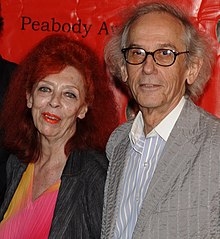 Jeanne-Claude and Christo in May 2009 | |
| Known for | Ecology fine art |
| Notable work | Running Argue The Gates The Floating Piers |
| Motility | Nouveau réalisme Environmental art |
| Awards | Praemium Imperiale |
| Born | Christo Vladimirov Javacheff (1935-06-13)June xiii, 1935 Gabrovo, Bulgaria |
| Died | May 31, 2020(2020-05-31) (aged 84) New York City, New York, U.S. |
| Pedagogy | Sofia Academy of Fine Arts Vienna Academy of Fine Arts |
| Born | Jeanne-Claude Denat de Guillebon (1935-06-13)June 13, 1935 Casablanca, French Morocco |
| Died | November eighteen, 2009(2009-11-18) (aged 74) New York City, New York, U.S. |
| Education | Cocky–taught |
| Website | christojeanneclaude |
Christo Vladimirov Javacheff (1935–2020) and Jeanne-Claude Denat de Guillebon (1935–2009), known as Christo and Jeanne-Claude, were artists noted for their large-calibration, site-specific environmental installations, often large landmarks and mural elements wrapped in fabric, including the Wrapped Reichstag, The Pont Neuf Wrapped, Running Fence in California, and The Gates in New York Metropolis's Cardinal Park.[1]
Born on the same twenty-four hours in Bulgaria and Kingdom of morocco, respectively, the pair met and married in Paris in the late 1950s. Originally working under Christo's proper name, they later on credited their installations to both "Christo and Jeanne-Claude". Until his own death in 2020, Christo connected to programme and execute projects afterward Jeanne-Claude'south expiry in 2009.
Their work was typically large, visually impressive, and controversial, often taking years and sometimes decades of careful preparation – including technical solutions, political negotiation, permitting and ecology approval, hearings and public persuasion. The pair refused grants, scholarships, donations or public money, instead financing the work via the sale of their own artwork.
Christo and Jeanne-Claude described the myriad elements that brought the projects to fruition as integral to the artwork itself, and said their projects independent no deeper pregnant than their firsthand aesthetic impact; their purpose being simply for joy, dazzler, and new ways of seeing the familiar.
Career [edit]
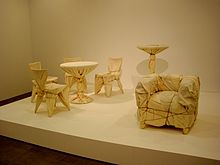
Würth Rioja wrapped chairs
Christo and Jeanne-Claude met in October 1958 when he was deputed to pigment a portrait of her female parent, Précilda de Guillebon.[2] Their offset bear witness, in Cologne, 1961, showcased the three types of artworks for which they would be known: wrapped items, oil barrels, and ephemeral, large-scale works.[3] Nearly Christo's kickoff solo show in Paris, in 1962, the pair blocked an alley with 240 barrels for several hours in a piece called Iron Curtain, a poetic reply to the Berlin Wall.[four]
They developed consistent, longtime terms of their collaboration. They together imagined projects, for which Christo would create sketches and preparatory works that were subsequently sold to fund the resulting installation. Christo and Jeanne-Claude hired assistants to exercise the piece of work of wrapping the object at manus. They originally worked under the name "Christo" to simplify dealings and their brand,[five] given the difficulties of establishing an creative person's reputation and the prejudices against female person artists,[half dozen] just they would later retroactively credit their big-calibration outdoor works to both "Christo and Jeanne-Claude".[v] They eventually flew in separate planes such that, in case one crashed, the other could continue their piece of work.[vii]
The couple relocated to New York City, the new fine art world capital, in 1964. Christo began to brand Store Fronts, wooden facades made to resemble shop windows, which he continued for iv years. His largest slice was shown in the 1968 Documenta 4. In the mid-1960s, they also created Air Packages,[8] inflated and wrapped research balloons.[nine] In 1969, at the invitation of the museum director Jan van der Marck they wrapped the Chicago Museum of Contemporary Fine art while it remained open.[10] Information technology was panned past the public and ordered to be undone past the burn down department, which went unenforced.[11] With the help of Australian collector John Kaldor, Christo and Jeanne-Claude and 100 volunteers wrapped the coast of Sydney'south Lilliputian Bay as Wrapped Coast, the get-go piece for Kaldor Public Art Projects.[12]
1970s [edit]

Within a year of Wrapped Coast, Christo began work on Valley Curtain:[13] an orangish curtain of fabric to be hung across the mountainous Colorado State Highway 325.[xiv] They simultaneously worked on Wrapped Walk Ways (Tokyo and Holland) and Wrapped Isle (Southward Pacific), neither of which came to fruition.[13] The artists formed a corporation to benefit from tax and other liabilities, a course they used for later projects.[13] Following a failed attempt to mount the curtain in late 1971, a new engineer and builder-contractor raised the fabric in August 1972. The piece of work only stood for 28 hours before the current of air over again destroyed the fabric. This work, their most expensive to date and showtime to involve structure workers, was captured in a documentary by David and Albert Maysles.[14] Christo'due south Valley Curtain was nominated for Best Documentary Short in the 1974 University Awards.[15] The Maysles would moving-picture show many of the artists' afterwards projects.[14]
Inspired by a snowfall fence, in 1972, Christo and Jeanne-Claude began preparations for Running Fence: a 24.5-mile fence of white nylon, supported by steel posts and steel cables, running through the Californian mural and into the sea. In substitution for temporary utilize of ranch state, the artists agreed to offer payment and apply of the deconstructed building materials. Others challenged its construction in eighteen public hearings and three state courtroom sessions. The fence began construction in Apr 1976 and the project culminated in a two-week display in September, after which it was deconstructed.[16]
Their 1978 Wrapped Walk Ways covered paths within Kansas Urban center, Missouri's Loose Park in fabric.[17]
1980s [edit]

Christo and Jeanne-Claude planned a project based on Jeanne-Claude's thought to surround 11 islands in Miami'south Biscayne Bay with 603,850 yard2 (6,499,800 sq ft) of pink polypropylene floating fabric. Surrounded Islands was completed on May vii, 1983, with the assist of 430 workers and could be admired for two weeks. The workers were outfitted with pinkish long sleeve shirts with stake blueish text written on the back reading "Christo Surrounded Islands", and then in acknowledging the garment'due south designer, "designed and produced by Willi Smith".[eighteen]
Jeanne-Claude became an American citizen in March 1984.[19] The couple received permission to wrap the Pont Neuf, a bridge in Paris, in August 1985. The bridge stayed wrapped for two weeks. The Pont Neuf Wrapped attracted three million visitors.[twenty] Wrapping the Pont Neuf connected the tradition of transforming a sculptural dimension into a work of art. The fabric maintained the chief shapes of the Pont Neuf but information technology emphasized the details and the proportions. As with Surrounded Islands, workers who assisted with the installation and deinstallation of Pont Neuf Wrapped wore uniforms designed by Willi Smith.[18]
1990s [edit]

The Umbrellas, 1991, Japan
Their 1991 The Umbrellas involved the simultaneous setup of blue and gold umbrellas in Japan and California, respectively. The 3,100-umbrella project price Usa$26 one thousand thousand and attracted three meg visitors.[21] Christo airtight the exhibition early after a woman was killed past a windblown umbrella in California.[22] Separately, a worker was killed during the deconstruction of the Japanese exhibit.[23]
Christo and Jeanne-Claude wrapped the Berlin Reichstag building in 1995 following 24 years of governmental lobbying beyond six Bundestag presidents. Wrapped Reichstag 'southward 100,000 square meters of silver cloth draped the building, fastened with bluish rope.[24] Christo described the Reichstag wrapping every bit autobiographical based on his Bulgarian upbringing.[25] The wrapping became symbolic of unified Germany and marked Berlin'southward return as a earth city.[26] The Guardian posthumously described the work equally their "most spectacular accomplishment".[27]
In 1998, the artists wrapped trees at the Beyeler Foundation and its nearby Berower Park. Prior attempts had failed to secure government back up in Saint Louis, Missouri, and Paris. The work was self-funded through sale of photographic documentation and preparatory works, as had get standard for the couple.[28]
The Gates [edit]

Work began on the installation of the couple's most protracted projection, The Gates, in New York City'southward Primal Park in January 2005. Its full title, The Gates, Central Park, New York, 1979–2005, refers to the time elapsed betwixt the year of the artists' initial proposal and the year they were allowed to proceed, having received permission from the newly elected mayor Michael R. Bloomberg.[29] The Gates was open to the public from February 12–27, 2005. A full of seven,503 gates made of saffron-colored fabric were placed on paths in Central Park. They were five meters (sixteen ft) high and had a combined length of 37 km (23 mi). The mayor presented them with the Doris C. Freedman Award for public art.[30] The project cost an estimated Us$21 meg, which the artists planned to compensate past selling projection documentation.[31]
Big Air Packet [edit]
Christo filled the Gasometer Oberhausen from March 16 until Dec 30, 2013 with the installation Big Air Package. Afterwards The Wall (1999) as the final installation of the Emscher Park International Building Exhibition, Big Air Parcel was his second piece of work of art in the Gasometer. The "Big Air Package – Project for Gasometer Oberhausen, Germany" was conceived by Christo in 2010 (for the first fourth dimension without his wife Jeanne-Claude). The sculpture was set in the interior of the industrial monument and was fabricated of twenty,350 grand3 (719,000 cu ft) of translucent cloth and 4,500 k (fourteen,800 ft) of rope. In the inflated state, the envelope, with a weight of 5.3 tonnes (5.8 short tons), reached a elevation of more than xc chiliad (300 ft), a bore of l 1000 (160 ft) and a volume of 177,000 m3 (6,300,000 cu ft). The monumental work of art was, temporarily, the largest cocky-supporting sculpture in the earth. In the attainable interior of Large Air Package, the artist generated a unique feel of infinite, proportions, and light.[32]
X-TO+J-C: Christo and Jeanne-Claude Featuring Works from the Bequest of David C. Copley [edit]
In 2014, the Museum of Gimmicky Art San Diego presented the exhibit Ten-TO + J-C: Christo and Jeanne-Claude Featuring Works from the Bequest of David C. Copley, one of the museum's patrons and trustees who also had the largest collection of Christo and Jeanne-Claude's work in the Us.[33] X-TO + J-C featured more than fifty works by Christo and Jeanne-Claude, including pieces such equally Christo'due south evocative Package (1960), alongside drawings related to his early concealed objects: chairs, road signs, and other commonplace items.[34] Christo himself gave a lecture in which he discussed two works that were in progress:Over the River, Project for the Arkansas River, Colorado, and The Mastaba, Project for the United Arab Emirates.[35]
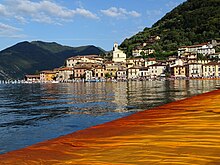
The Pier at Peschiera Maraglio
The Floating Piers [edit]
The Floating Piers were a series of walkways installed at Lake Iseo nearly Brescia, Italian republic. From June 18 to July three, 2016, visitors were able to walk just to a higher place the surface of the water from the village of Sulzano on the mainland to the islands of Monte Isola and San Paolo. The floating walkways were made of around 200,000 polyethene cubes covered with 70,000 g2 (750,000 sq ft) of bright yellow fabric: iii km (i.ix mi) of piers moved on the water; another 1.5 km (0.93 mi) of golden fabric continued along the pedestrian streets in Sulzano and Peschiera Maraglio. After the exhibition, all components were to be removed and recycled.[36] The installation was facilitated by the Beretta family unit, owners of the oldest agile manufacturer of firearm components in the world and the chief sidearm supplier of the U.S. Ground forces.[37] The Beretta family owns the island of San Paolo, which was surrounded by Floating Piers walkways.[38] The work was a success with the Italian public and critics likewise.[39] [40] [41]
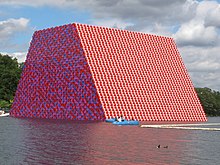
The London Mastaba [edit]
The London Mastaba was a temporary floating installation exhibited from June to September 2018 on The Serpentine in London. The installation consisted of seven,506 oil barrels, in the shape of a mastaba, a form of an early bench, also as a style of tomb, in use in ancient Mesopotamia, with a flat roof and inward sloping sides. Information technology sat on a floating platform of loftier-density polyethene, held in place past 32 anchors. It was 20 m (66 ft) in peak and weighed 600 tonnes (660 short tons). The vertical ends were painted in a mosaic of cerise, blue and mauve, whilst the sloping sides were in red with bands of white.[42]
Simultaneously with the brandish of The London Mastaba, the nearby Serpentine Gallery presented an exhibition of the artists' work, entitled Christo and Jeanne-Claude: Barrels and The Mastaba 1958–2018. The exhibition comprised sculptures, drawings, collages, calibration-models and photographs from the last 60 years of the artists' work.[43]
Another Mastaba of over 400,000 oil barrels is intended to exist built at Al Gharbia, 160 km (100 mi) from the city Abu Dhabi.[44] [45]
Over the River [edit]
Christo and Jeanne-Claude announced plans for a future project, titled Over The River, to be constructed on the Arkansas River between Salida, Colorado, and Cañon City, Colorado, on the eastern slope of the Rocky mountains. Plans for the project call for horizontally suspending 10.8 km (vi.7 mi) of reflective, translucent fabric panels loftier to a higher place the h2o, on steel cables anchored into the river'due south banks. Projection plans called for its installation for two weeks during the summer of 2015, at the primeval, and for the river to remain open up to recreation during the installation. Reaction among area residents was intense, with supporters hoping for a tourist boom and opponents fearing that the projection would ruin the visual appeal of the landscape and inflict damage on the river ecosystem. One local rafting guide compared the project to "hanging pornography in a church." The U.South. Bureau of Land Management released a Record of Determination approving the projection on Nov vii, 2011.[46] [47] [48] Work on the project cannot begin, nevertheless, until the Bureau of State Management problems a Notice to Go along.[49] A lawsuit against the Colorado Sectionalization of Parks and Wildlife was filed on July 22, 2011, by Rags Over the Arkansas River (ROAR), a local grouping opposed to the project.[50] The lawsuit is nevertheless awaiting a court date.[51]
Christo and Jeanne-Claude'south inspiration for Over the River came in 1985 equally they were wrapping the Pont-Neuf and a fabric panel was being elevated over the Seine. The artists began a iii-year search for advisable locations in 1992, considering some eighty-nine river locations. They chose the Arkansas River because its banks were high enough that recreational rafters could enjoy the river at the aforementioned time.[52]
Christo and Jeanne-Claude spent more than than $six million on environmental studies, design applied science, and air current tunnel testing of fabrics. As with past projects, Over The River would be financed entirely past Christo and Jeanne-Claude, through the sale of Christo'south preparatory drawings, collages, scale models, and early on works of the 1950s/1960s. On July 16, 2010, the U.S. Agency of Land Management released its four-volume Draft Environmental Affect Statement, which reported many potentially serious types of adverse impact but as well many proposed "mitigation" options.[53] [54]
In January 2017, later the election of President Trump, Christo canceled the controversial project citing protest of the new administration likewise as tiring from the difficult-fought legal battle waged by local residents.[55] [56]
L'Arc de Triomphe, Wrapped [edit]
Standing their series of awe-inspiring "wrapping" projects, the Arc de Triomphe in Paris was wrapped in 30,000 square meters of recyclable polypropylene fabric in silvery blue, and seven,000 meters (23,000 feet) of ruby-red rope. Originally scheduled for autumn of 2020,[57] it was postponed a year to Saturday, September 18 to Dominicus, October three, 2021, due to the COVID-nineteen pandemic in France and its impact on the arts and cultural sector worldwide.[58] Following Christo'southward expiry, his office stated that the projection would nevertheless be completed.[59]
Several articles in the press cut the name of Jeanne-Claude on their coverage of the event leading to a debate about the suppression of the place of women in fine art history.[lx] [61] [62] [63]
Reception [edit]
Christo and Jeanne-Claude'south work is held by many major public collections.[64] The artists received the 1995 Praemium Imperiale,[65] the 2006 Vilcek Prize,[66] and the 2004 International Sculpture Center's Lifetime Achievement in Contemporary Sculpture Award.[67] Fine art critic David Bourdon described Christo's wrappings every bit a "revelation through darkening."[68] Unto his critics Christo replied, "I am an artist, and I take to have courage ... Do you lot know that I don't have any artworks that exist? They all get away when they're finished. Merely the preparatory drawings, and collages are left, giving my works an almost legendary graphic symbol. I recall information technology takes much greater courage to create things to be gone than to create things that volition remain."[69] Jeanne-Claude was a house believer in the aesthetic beauty of works of art; she said, "'We desire to create works of art of joy and beauty, which we will build because nosotros believe it volition be beautiful.'"[five]
Biographies [edit]
Christo [edit]

Christo Vladimirov Javacheff (Bulgarian: Христо Владимиров Явашев, [xrisˈtɔ vlɐˈdimirof jaˈvaʃɛf]) was built-in on June 13, 1935, in Gabrovo, Bulgaria, as the second of three sons to Tzveta Dimitrova (a Macedonian Bulgarian from Thessaloniki) and Vladimir Javacheff, who worked at a cloth manufacturer.[70] Christo was shy[71] and had a predilection for art. He received individual art instruction at a young age and the support of his parents,[70] who invited visiting artists to their house.[72] Christo was particularly affected past events from Globe War II and the country's fluid borders.[73] During evacuations, he and his brothers stayed with a family in the rural hills outside boondocks, where Christo continued with nature and handicraft.[74]
While Bulgaria was nether repressive totalitarian rule, and Western art was suppressed, Christo pursued realistic painting through the mid-1950s. He was admitted into the Sofia Academy of Fine Arts in 1953[75] only constitute the school dull and stifling.[76] Instead, he found inspiration in Skira art books, and visiting Russian professors who were older than he and once agile in Russian modernism and the Soviet avant-garde. On the weekends, academy students were sent to pigment propaganda and Christo unhappily participated.[77] He found piece of work equally a location scout for the state cinema and served three tours of duty during summertime breaks.[78] In 1956, he used an academy connectedness to receive permission to visit family in Prague,[79] where the theater of Emil František Burian reinvigorated him.[80] Among fears of farther Russian suppression in Republic of hungary, Christo decided to abscond to Vienna as a railcar stowaway. He had little money after paying the bribe, did not speak the linguistic communication, had deserted during his Bulgarian military service, and feared existence trapped in a refugee camp.[81]
In Vienna, he stayed with a family friend (who had non expected him), studied at the Vienna Fine Arts Academy, and surrendered his passport to seek political aviary as a stateless person.[82] In that location, he supported himself with commissions and briefly visited Italy with the academy, whose plan he found as unhappy as the one earlier it. At the behest of a friend relocated from Sofia, he saved up to visit Geneva in tardily 1957.[83] In violation of his visa, he continued to pursue commissions (whose works he would sign with his family proper noun, reserving his given proper name for more serious work) and was transformed later on visiting the Kunstmuseum Basel and Kunsthaus Zürich.[84] In January 1958, he first began to wrap things, as would become his trademark, starting with a pigment tin.[85] His collection of wrapped household items would be known as his Inventory. In February 1958, Christo left for Paris, having received a visa with the assistance of a Sofia academy connection.[86]
In 1973, subsequently 17 stateless years, Christo became a The states citizen.[87] He died at his habitation in New York Metropolis on May 31, 2020, at 84. No cause of death was specified.[88] 50'Arc de Triomphe, Wrapped, a planned work by Christo and Jeanne-Claude, went ahead posthumously in Paris in September 2021.[89]
Jeanne-Claude [edit]
Jeanne-Claude Denat de Guillebon (French: [ʒan klod dəna də gijəbɔ̃]) was born in Casablanca, Kingdom of morocco, where her begetter, an regular army officeholder, was stationed. Her mother, Précilda, was 17 when she married Jeanne-Claude's begetter, Major Léon Denat. Précilda and Léon Denat divorced shortly after Jeanne-Claude was built-in, and Précilda remarried three times. Jeanne-Claude earned a baccalauréat in Latin and philosophy in 1952 from the University of Tunis.[v] After Précilda married the General Jacques de Guillebon in 1947, the family lived in Bern (1948–1951) and Tunisia (1952–1957) before returning to Paris.[ninety]
Jeanne-Claude was described as "extroverted" and with natural organizational abilities. Her hair was dyed red, which she claimed was selected past her hubby.[91] She took responsibleness for overseeing piece of work crews and for raising funds.[7]
Jeanne-Claude died in New York City on November 18, 2009, from complications due to a brain aneurysm. Her body was to be donated to scientific discipline, i of her final wishes.[92] When she died, she and Christo were at piece of work on Over the River [93] and the United Arab Emirates project, The Mastaba.[5] She said, "Artists don't retire. They die. That'due south all. When they stop being able to create art, they dice."[94]
Marriage [edit]
Christo and Jeanne-Claude met in Oct 1958 when he was commissioned to paint a portrait of her mother, Précilda de Guillebon.[two] Initially, Christo was attracted to Jeanne-Claude'south half-sister, Joyce. Jeanne-Claude was engaged to Philippe Planchon.[95] Before long before her hymeneals, Jeanne-Claude became pregnant by Christo. Although she married Planchon, Jeanne-Claude left him immediately after their honeymoon.[96] Christo and Jeanne-Claude's son, Cyril, was born on May 11, 1960.[97]
See as well [edit]
- Land art
Notes [edit]
- ^ "Artist Christo, known for wrapping exteriors of landmarks, dies at 84". Reuters. June 1, 2020. Retrieved June 8, 2020.
- ^ a b Chernow 2002, pp. lx–61.
- ^ Fineberg 2004, p. 18.
- ^ Fineberg 2004, p. 19.
- ^ a b c d east Grimes, William (November nineteen, 2009). "Jeanne-Claude, Christo'southward Collaborator on Environmental Canvas, Is Dead at 74". The New York Times. ISSN 0362-4331.
- ^ Lewis, Richard, and Susan Lewis. "Cengage Reward Books: The Ability of Art." Google Books. Cengage Learning, January 23, 2008. Web. March four, 2015.
- ^ a b Miller, Stephen; Crow, Kelly (November 20, 2009). "Part of a Artistic Powerhouse Behind Imperceptible Artworks". The Wall Street Journal. Dow Jones. Retrieved November twenty, 2009.
- ^ Baal-Teshuva 2001, p. 27.
- ^ Baal-Teshuva 2001, p. 28.
- ^ Grimes, William (May eight, 2010). "Jan van der Marck, Museum Administrator, Dies at 80 (Published 2010)". The New York Times. ISSN 0362-4331. Retrieved January 30, 2021.
- ^ Baal-Teshuva 2001, p. 32.
- ^ Blake, Elissa (June 1, 2020). "Christo'south Wrapped Declension: how the monumental Australian work was made – and changed art history". The Guardian. ISSN 0261-3077.
- ^ a b c Fineberg 2004, p. 31.
- ^ a b c Fineberg 2004, p. 32.
- ^ Gates, Anita (March 6, 2015). "Albert Maysles, Pioneering Documentarian, Dies at 88". The New York Times. ISSN 0362-4331.
- ^ Hendry, Erica R. (June 2010). "Christo's California Dreamin'". Smithsonian Magazine . Retrieved June 1, 2020.
- ^ Cowdy, Richard (1982). "Review of Christo: Wrapped Walk Ways. Loose Park, Kansas Metropolis, Missouri, 1977-78". Leonardo. 15 (1): 79. doi:10.2307/1574371. ISSN 0024-094X. JSTOR 1574371.
- ^ a b Earnest, Jarrett (2020). "Willi Smith in Pieces". In Cunningham Cameron, Alexandra (ed.). Willi Smith: Street Couture. New York: Rizzoli Electa. pp. 50–53. ISBN978-0-8478-6819-3.
- ^ Chernow 2002, p. 312.
- ^ Fineberg 2004, p. 42.
- ^ Fineberg 2004, p. 44.
- ^ "Christo Umbrella Crushes Woman". The New York Times. The Associated Press. October 28, 1991. ISSN 0362-4331.
- ^ "2d Person Is Killed in Christo Art Project". The New York Times. The Associated Press. November 1, 1991. ISSN 0362-4331.
- ^ da Silva, José (June one, 2020). "Christo and Jeanne-Claude's greatest hits". The Art Paper . Retrieved June two, 2020.
- ^ Artner, Alan Grand. (April 6, 1986). "Christo Finds the Going Getting Rougher as He Wraps His Manner Around the World". Chicago Tribune . Retrieved June two, 2020.
- ^ Warde-Aldam, Digby (June xix, 2018). "Understanding Christo and Jeanne-Claude through 6 Pivotal Artworks". Artsy . Retrieved June 2, 2020.
- ^ Needham, Alex (May 31, 2020). "Christo, artist who wrapped the Reichstag, dies aged 84". The Guardian. ISSN 0261-3077.
- ^ Greenberger, Alex (April three, 2020). "Enormous Wrappings by Christo and Jeanne-Claude, Ranked past Size: From Covered Monuments to Mountainside Defunction". ARTnews.com . Retrieved June 2, 2020.
- ^ Tompkins, Calvin. "The Gates to the City. How the Christos program to transform Central Park". The New Yorker. No. March 29, 2004. pp. 74–85. Archived from the original on March 29, 2004. Retrieved August 6, 2019.
- ^ "2005: Art Earth Yr-in-Review". Artinfo. Dec 25, 2005. Archived from the original on October fourteen, 2012. Retrieved April 17, 2008.
- ^ McIntire, Mike (March 5, 2005). "Plenty Well-nigh 'Gates' equally Fine art; Let's Talk About That Cost Tag". The New York Times. ISSN 0362-4331.
- ^ NoFavorite. "Projects – Big Air Parcel". world wide web.christojeanneclaude.net . Retrieved April fifteen, 2018.
- ^ "Christo Lectures At MCASD To Open Showroom". KPBS Public Media. January 31, 2014. Retrieved January 24, 2022.
- ^ "XTO + J-C: Christo and Jeanne-Claude exhibition opens at the Museum of Gimmicky Art San Diego". artdaily.cc . Retrieved January 24, 2022.
- ^ "MUSEUM OF CONTEMPORARY Fine art SAN DIEGO (MCASD) PRESENTS X-TO + J-C: CHRISTO AND JEANNE-CLAUDE FEATURING WORKS FROM THE Heritance OF DAVID C. COPLEY". Museum of Contemporary Art San Diego. January 13, 2014. Retrieved January 24, 2022.
- ^ "Christo: The Floating Piers, Project for Lake Iseo, Italy". christojeanneclaude.cyberspace . Retrieved September 7, 2015.
- ^ "Esplora il meaning del termine: La signora Beretta e l'isola di Famiglia nell'opera di Christo da fifteen million di euroLa signora Beretta e 50'isola di Famiglia nell'opera di Christo da 15 milioni di euro". corriere.information technology . Retrieved April 8, 2016.
- ^ Mesco, Manuela (June eighteen, 2016). "Christo Walks on Water With New Italian Installation". The Wall Street Journal . Retrieved July 19, 2016.
- ^ "I x tipi da The Floating Piers Analisi ironica di un successo". July seven, 2016. Retrieved May 31, 2020.
- ^ "The Floating Piers, Christo: "E' stato united nations successo"". ilgiorno.it. ilgiorno.information technology. July 13, 2016. Retrieved May 31, 2020.
- ^ "Christo. Riflessioni finali su The Floating Piers". darsmagazine.it. July 4, 2016. Retrieved May 31, 2020.
- ^ Block, Bharat (June 18, 2018). "Christo unveils floating Serpentine sculpture made from 7,506 barrels". De Zeen. Archived from the original on June 18, 2018. Retrieved June eighteen, 2018.
- ^ "Christo and Jeanne-Claude: Barrels and The Mastaba 1958–2018". Serpentine Gallery. Archived from the original on June 22, 2018. Retrieved June 22, 2018.
- ^ "The Mastaba". Christo and Jeanne-Claude . Retrieved January 27, 2017.
- ^ Ng, David (Nov 26, 2012). "Will Christo's oil-barrel pyramid 'Mastaba' finally rise?". Los Angeles Times. Archived from the original on March 12, 2013. Retrieved March 12, 2013.
- ^ Blevins, Jason (August 22, 2010). "Local viewpoints wide apart on Christo's programme to mantle fabric over Arkansas River". Denver Mail service.
- ^ Crow, Kelly (September 10, 2010). "Christo vs. Colorado". The Wall Street Journal September ten, 2010.
- ^ "BLM Over The River Record of Conclusion". Bureau of Country Management. November 7, 2011. Archived from the original on February 1, 2012.
- ^ "News and Events". Rags Over the Arkansas River (ROAR). November 21, 2011. Archived from the original on November xi, 2011.
- ^ Blevins, Jason (July 27, 2011). "Foes of Christo's programme to cover Arkansas River with cloth sue state park board". Denver Post.
- ^ Ericka, Kastner (Nov i, 2011). "OTR lawsuit awaits court appointment". The Mountain Mail.
- ^ Cathy, Newman (Nov 2006). "Christo and Jeanne-Claude Unwrapped". National Geographic.
- ^ Johnson, Kirk (July 16, 2010). "Bureaucracy Meets Art, Delighting Christo". The New York Times July 17, 2010.
- ^ Crow, Kelly (September ten, 2010). "Christo vs. Colorado". The Wall Street Periodical . Retrieved April 15, 2018 – via www.wsj.com.
- ^ Randy Kennedy, Christo, Trump and the Fine art World's Biggest Protest Notwithstanding The New York Times 2017/01/25
- ^ Corey H. Jones, Artist Christo Calls Off Colorado Project After Long Legal Battle Colorado Public Radio January 25, 2017
- ^ Lauter, Devoran (March 26, 2020). ""I Use the Capitalist Arrangement to the Very End": Christo on What It's Like to Achieve His Dream of Wrapping the Arc de Triomphe". artnet News . Retrieved May 10, 2020.
- ^ "L'Arc de Triomphe, Wrapped". christojeanneclaude.net.
- ^ Artist Christo, famed for wrapping landmarks in cloth, dies at 84, France24, May 31, 2020, online: france24.com/...
- ^ Brugvin, Margaux (September 21, 2021). "Le triomphe de Christo et l'effacement de Jeanne-Claude". i-D (in French). Retrieved September 29, 2021.
- ^ "Jeanne-Claude, the creative person hidden behind the Arc de Triomphe packaged (non only by Christo)". News in 24 Lifestyle English. September 18, 2021. Retrieved September 29, 2021.
- ^ "Pourquoi l'installation de Christo et Jeanne-Claude sur l'Arc de triomphe fait débat ?". Konbini Arts - Photographie et arts sans filtre par Konbini (in French). Retrieved September 29, 2021.
- ^ Rockefeller, Hall W. (September 22, 2021). "Give Jeanne-Claude Her Rightful Credit". Hyperallergic . Retrieved September 29, 2021.
- ^ "Christo and Jeanne-Claude Biography". Artnet . Retrieved June 1, 2020.
- ^ "Lloyd Webber Wins Prize". The New York Times. June xvi, 1995. ISSN 0362-4331.
- ^ Cash, Stephanie; Ebony, David (May 2006). "Awards & Grants". Art in America. Vol. 94, no. 5. p. 206. ISSN 0004-3214. ProQuest 219749045.
- ^ "ISC Board Meets in New York". Sculpture. 23: 80. 2004.
- ^ Bourdon, David: "Christo", Harry North. Abrams Publishers, Inc., New York Metropolis, 1970.
- ^ Gilbert, Rita; Getlein, Marking (2002). Gilbert's Living with Art. McGraw-Hill. p. 276. ISBN978-0-07-231726-8.
- ^ a b Chernow 2002, p. 4.
- ^ Chernow 2002, p. 11.
- ^ Chernow 2002, p. 13.
- ^ Chernow 2002, p. 5–6.
- ^ Chernow 2002, p. 9.
- ^ Chernow 2002, p. 15.
- ^ Chernow 2002, p. 17.
- ^ Chernow 2002, p. xix.
- ^ Chernow 2002, p. 20.
- ^ Chernow 2002, p. 22.
- ^ Chernow 2002, p. 23.
- ^ Chernow 2002, p. 24.
- ^ Chernow 2002, p. 25.
- ^ Chernow 2002, pp. 46–48.
- ^ Chernow 2002, p. 49.
- ^ Chernow 2002, p. l.
- ^ Chernow 2002, pp. 51–52.
- ^ Randy Kennedy (Jan 25, 2017). "Christo, Trump and the Art World's Biggest Protestation Nevertheless". The New York Times.
- ^ "Christo, artist known for massive, fleeting displays, dies". Associated Press. May 31, 2020. Retrieved May 31, 2020.
- ^ Needham, Alex (May 31, 2020). "Christo, artist who wrapped the Reichstag, dies anile 84". The Guardian. ISSN 0261-3077. Retrieved June 1, 2020.
- ^ Chernow 2002, pp. 37–43.
- ^ Vogel, Carol (Oct 21, 2015). "Next From Christo: Art That Lets You Walk on H2o". The New York Times . Retrieved April 15, 2018.
- ^ "Artist Jeanne-Claude dies aged 74". BBC News. November xx, 2009. Retrieved Nov 19, 2009.
- ^ Hoelterhoff, Manuela (Nov 20, 2009). "Jeanne-Claude – Christo's Dynamic Muse". Bloomberg News. Archived from the original on January 18, 2013. Retrieved November 20, 2009.
- ^ Schudel, Matt (November 20, 2009). "Jeanne-Claude and Christo". The Washington Post . Retrieved November 20, 2009.
- ^ Chernow 2002, pp. 69–70.
- ^ Chernow 2002, p. 75.
- ^ Bryan, Kate (2019). The Art of Dear: The Romantic and Explosive Stories Behind Fine art's Greatest Couples. White Lion Publishing. p. 32. ISBN978-0-7112-4032-2.
Bibliography [edit]
- Baal-Teshuva, Jacob (2001). Christo and Jeanne-Claude. Taschen. ISBN978-3-8228-5996-four.
- Chernow, Burt (2002). Christo and Jeanne-Claude: A Biography. Macmillan. ISBN978-0-312-28074-i.
- Fineberg, Jonathan David (2004). Christo and Jeanne-Claude: On the Way to The Gates, Fundamental Park, New York City. Yale Academy Press. ISBN978-0-300-10405-9.
- This article is based on a translation of the corresponding article from the German Wikipedia, accessed on May 3, 2005, with additional fabric on the Over the River projection from the artists' website and newspapers.
Further reading [edit]
The early work of Christo and Jeanne-Claude [edit]
- Matthias Koddenberg, Christo: The Paris Sculptures 1961, Kettler Verlag, Bönen, Germany 2011
- Matthias Koddenberg, Christo and Jeanne-Claude: Early Works 1958–64, Kettler Verlag, Bönen, Deutschland 2009
- Matthias Koddenberg, "Christo and Jeanne-Claude: Realism'southward Newly Unveiled Face", in: Nouveau Réalisme, exh. true cat. Museum Moderner Kunst Stiftung Ludwig Wien, Vienna, Austria 2005
- David Bourdon, Christo, Harry N. Abrams, New York, 1971
Specific projects of Christo and Jeanne-Claude [edit]
- Wark, Wesley One thousand., Christo: A New Work in Miami / An Imaginary Visit to Scotland, in Cencrastus No. 9, Summer 1982, pp. 10 - 12, ISSN 0264-0856
- Anne L. Strauss, Christo and Jeanne-Claude: The Gates, Central Park, New York Metropolis, 1979–2005, Taschen Verlag, Cologne, Germany 2005
- Christo: 5.600 Cubicmeter Package, Verlag Wort und Bild, Baierbrunn, Deutschland 1968
- Five Films nearly Christo & Jeanne-Claude: A Maysles Films Production, New York: Plexifilm, 2004.
Life and work of Christo and Jeanne-Claude [edit]
- Matthias Koddenberg, Christo and Jeanne-Claude: In/Out Studio, D.A.P., New York, 2015
- Christo and Jeanne-Claude: xl Years – 12 Exhibitions, exh. cat. Annely Juda Fine Art, London, Groovy Britain 2011
- Jacob Baal-Teshuva, Christo and Jeanne-Claude, Taschen Verlag, Cologne, Germany 2005
- Burt Chernow, Christo and Jeanne-Claude: A Biography, St. Martin's Press, New York, 2002
External links [edit]
- Official website

- Works by or almost Christo in libraries (WorldCat catalog)
- Works by or about Jeanne-Claude in libraries (WorldCat catalog)
Source: https://en.wikipedia.org/wiki/Christo_and_Jeanne-Claude
0 Response to "Are Christo and Jean Claude Art 2d or 3d?"
Post a Comment