What Are the First Ancient Greek Books I Should Read Anabasis
Greek literature has influenced not only its Roman neighbors to the west but also endless generations across the European continent. Greek writers are responsible for the introduction of such genres as poetry, tragedy, comedy, and western philosophy to the globe. These Greeks authors were born not only on the soil of their native Hellenic republic but as well in Asia Minor (Ionia), the islands of the Aegean, Sicily, and southern Italy.
Themes
The Greeks were a passionate people, and this zeal can be seen in their literature. They had a rich history of both state of war and peace, leaving an indelible imprint on the culture and people. Writer and historian Edith Hamilton believed that the spirit of life abounds throughout Greek history. In her The Greek Way she wrote,
Greek literature is not done in gray or with a low palette. It is all black and shining white or black and scarlet and golden. The Greeks were keenly enlightened, terribly aware, of life's doubtfulness and the imminence of decease. Over and over again they emphasize the brevity and the failure of all human endeavor, the swift passing of all that is beautiful and blithesome. [...] Joy and sorrow, exultation and tragedy, stand manus in hand in Greek literature, but there is no contradiction involved thereby. (26)
To fully understand and appreciate Greek literature i must separate information technology, divide the oral epics from the tragedies and comedies equally well every bit the histories from the philosophies. Greek literature can also exist divided into singled-out periods: Archaic, Classical, and Hellenistic. The literature of the Archaic era generally centered on myth; role history and part folklore. Homer'south epics of the Iliad and the Odyssey and Hesiod'due south Theogony are significant examples of this period. Literary Hellenic republic begins with Homer. Since writing had non yet arrived in Greece, much of what was created in this period was communicated orally, simply to be put in written class years later.
The Classical era (4th and 5th centuries BCE) centered on the tragedies of such writers as Sophocles and his Oedipus Male monarch, Euripides's Hippolytus, and the comedies of Aristophanes. Lastly, the final period, the Hellenistic era, saw Greek poetry, prose, and culture expand across the Mediterranean influencing such Roman writers as Horace, Ovid, and Virgil. Unfortunately, with only a few exceptions, much of what was created during the Archaic and Classical period remains only in fragments.
Archaic Period
During the Archaic flow, the poets' works were spoken - an outcome of an oral tradition - delivered at festivals. A product of Greece's Dark Ages, Homer'southward ballsy the Iliad centered on the terminal days of the Trojan War, a state of war initiated by the dear of a beautiful woman, Helen. It brought an array of heroes such every bit Achilles, Hector, and Paris to generations of Greek youth. It was a verse form of contrasts: gods and mortals, divine and man, war and peace. Alexander the Great slept with a copy of the book nether his pillow and fifty-fifty believed he was related to Achilles.
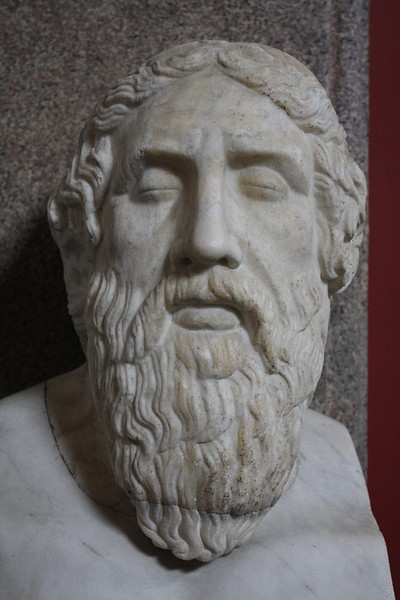
Homer
Homer's 2nd work, the Odyssey, revolved around the ten-year "odyssey" of the Trojan State of war hero Odysseus and his attempt to render home. While virtually classicists and historians take that Homer actually lived, in that location are some who propose his epics are the effect of more than ane author. Whether his or not, Homer's works would one day greatly influence the Roman author Virgil and his Aeneid. After Homer, lyric poetry - poetry to be sung - came into its own.
Written down years later on his decease, Aesop's fables were among the outset printed works in vernacular English language.
There were many others who "wrote" during this menses, among them were Aesop, Hesiod, and Sappho. The noted storyteller Aesop may or may not be the great fabulist of the ancient world. Professor and classicist D. L. Ashilman in his introduction to the volume Aesop's Fables, wrote, "Aesop may not be a historical figure but rather a proper name that refers to a group of ancient storytellers." Convention claims that he was born a slave around 620 BCE in Asia Small. Subsequently he received his freedom, he traveled throughout Hellenic republic collecting stories, including The Mischievous Dog, The Lion and the Mouse, and The Monkey as Male monarch. These stories oftentimes ended (not always happily) with a moral such as honesty is the best policy, look before you lot jump, sky helps those who help themselves, and in one case bitten, twice shy. Written downward years after his death, Aesop'southward fables were among the beginning printed works in colloquial English.
Another poet of the Archaic Menstruum was Hesiod, the author of Theogony, a hymn to Apollo'due south Muses. He has been called the father of didactic poetry. Like Homer, niggling is known of his early life except that he came from Boeotia in central Greece. Theogony told of the origins and genealogies of the gods, the kingdom of Zeus. Hesiod wrote:
With the Heliconian Muses let u.s. start
Our song: they hold the great and godly mount
of Helicon, and on their delicate feet
They dance around the darkly bubbles spring
And round the altar of the mighty Zeus. (23)
Afterwards in the poem, he said:
Hail, daughters of Zeus
Give me sweetness song
To celebrate the holy race of gods
Who live forever, sons of starry Sky
And World, and gloomy Night, and salty Sea. (26)
His others works include Works and Days, The Shield of Herakles, and Catalogue of Women.
Lastly, one of the few female lyric poets of the period was Sappho, often called the tenth Muse. Born on the Aegean island of Lesbos, her poems were hymns to the gods and influenced such Romans poets equally Horace, Catullus, and Ovid. Much of her verse remains in fragments or quoted in the works of others.
Classical Period
Oral recitation of poesy, besides as lyric poetry, morphed into drama. The purpose of drama was to non only entertain just as well to educate the Greek denizen, to explore a trouble. Plays were performed in outdoor theaters and were commonly part of a religious festival. Along with a chorus of singers to explicate the activeness, there were actors, often iii, who wore masks. Of the known Greek tragedians, there are only three for whom there are complete plays: Aeschylus, Sophocles, and Euripides. Oddly, these are considered among the great tragic writers of the world. Hamilton wrote:
The great tragic artists of the world are four, and three of them are Greek. It is in tragedy that the pre-eminence of the Greeks can exist seen most clearly. Except for Shakespeare, the great three, Aeschylus, Sophocles, and Euripides stand lone. Tragedy is an achievement peculiarly Greek. They were the first to perceive information technology and they lifted information technology to its supreme height. (171)
Aeschylus (c. 525 - c. 456 BCE) was the earliest of the iii. Born in Eleusis around 525/4 BCE, he fought at the Battle of Marathon against the Persian invaders. His first play was performed in 499 BCE. His surviving works include Persians, Vii Against Thebes, Suppliants (a play that beat out Sophocles in a competition), Prometheus Bound, Oresteia. Office of the Oresteia trilogy, his nigh famous work was probably Agamemnon, a play centering on the render of the Trojan War commander to his wife Clytemnestra, who would eventually impale him. After killing her hubby she showed little remorse, she said
This duty is no business organization of yours.
He brutal by my mitt,
by my mitt he died, and by my manus
he will be cached, and nobody
in the business firm will weep. (99)
About of Aeschylus's plays were centered on Greek myth, portraying the suffering of homo and the justice of the gods. His works were among the first to have a dialogue between the play'due south characters.
Sophocles (c. 496 - c. 406 BCE) was the 2nd of the great tragic playwrights. Of his 120 plays performed in competition, but xx were victorious, losing far too many to Aeschylus. But 3 of his seven surviving plays are complete. His most famous piece of work, function of a trilogy, is Oedipus Rex or Oedipus the King, a play written 16 years after outset of the three, Antigone, a play almost Oedipus' daughter. The third in the series was Oedipus at Colonus, relaying the final days of the blinded king. The tragedy of Oedipus centered on a prophecy that foretold of a man who would impale the king (his male parent) and marry the queen (his mother). Unknowingly, that homo was Oedipus. However, the tragedy of the play is non that he killed his begetter and married his female parent but that he plant out well-nigh it; it was an exploration of the tragic character of a now blinded hero.
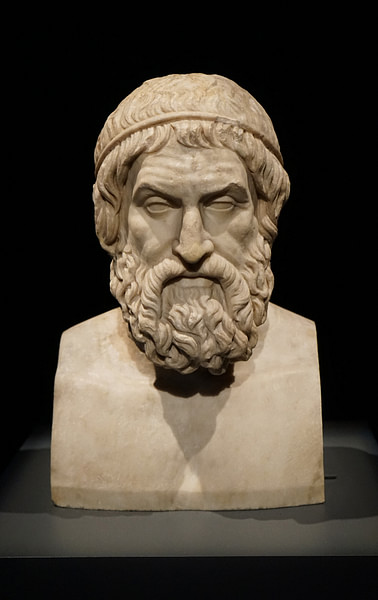
Bust of Sophocles
The third keen author of Greek tragedy was Euripides, an Athenian (c. 484 - 407 BCE). Unfortunately, his plays - often based on myth - were not very successful at the competitions; his critics often believe he was bitter near these losses. He was the author of 90 plays, among which are Hippolytus, Trojan Women, and Orestes. Euripides was known for introducing a second act to his plays, which were concerned with kings and rulers likewise as disputes and dilemmas. He died shortly afterwards traveling to Macedon where he was to write a play about the king'south coronation. His play Medea speaks of a bitter woman who took revenge against her married man by killing her children. In pain Medea screams:
O great Themis and lady Artemis, do you see what I endure, though I bound my accursed married man by weighty oaths? How I wish I might see him and his bride in utter ruin, business firm and all, for the wrongs they dare to inflict on me who never did them harm. (55)
Some other playwright of the era was the Athenian author of Greek comedy, Aristophanes (c. 450? - c. 386 BCE). Author of Old Comedy, his plays were satires of public persons and diplomacy equally well as candid political criticisms. Eleven of Aristophanes' plays have survived forth with 32 titles and fragments of others. His plays include Knights, Lysistrata, Thesmophoriazusae , The Frogs, and The Clouds, a play that ridiculed the philosopher Socrates every bit a corrupt instructor of rhetoric. His actors oftentimes wore grotesque masks and told obscene jokes. Many of his plays had a moral or social lesson, poking fun at the literary and social life of Athens.
Greek philosophers & Historians
Among the major contributors to Greek literature were the philosophers, among them Plato, Aristotle, Epictetus, and Epicurus. I of the most influential Greek philosophers was Plato (427-347 BCE). As a educatee of Socrates, Plato's early works were a tribute to the life and death of his instructor: Amends, Crito, and Phaedo. He also wrote Symposium, a series of speeches at a dinner party. All the same, his most famous work was The Commonwealth, a book on the nature and value of justice.
His pupil, Aristotle (384-322 BCE), disagreed with Plato on several issues, mainly the concept of empiricism, the idea that a person could rely on his/her senses for information. His many works include Nichomachean Ethics (a treatise on ethics and morality), Physics, and Poetics. He was the creator of the syllogism and a instructor of Alexander the Great.
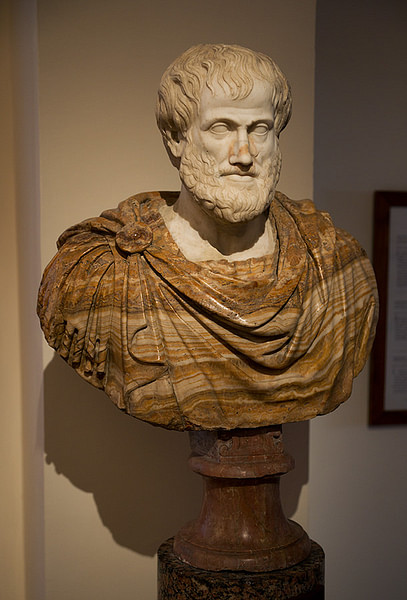
Aristotle Bust, Palazzo Altemps
A final group of contributors to ancient Greek literature are the historians: Herodotus, Thucydides, and Polybius. Both Herodotus (484 – 425 BCE) and Thucydides (460 – 400 BCE) wrote around the time of the Peloponnesian Wars. Although picayune is known of his early life, Herodotus wrote on both the wars betwixt Athens and neighboring Sparta as well as the Persian Wars. During his lifetime, his home of Halicarnassus in western Asia Small-scale was under Persian control. Although he is often criticized for factual errors, his accounts relied on earlier works and documents. His narratives demonstrate an understanding of the human feel and unlike previous writers, he did not approximate. He traveled extensively, fifty-fifty to Arab republic of egypt.
His contemporary, Thucydides, was the writer, although incomplete, of a History of the Peloponnesian State of war. Office of his history was written as it happened and looked at both long-range and short-range causes of the war. His massive unfinished work would be completed by such Greek authors equally Xenophon and Cratippus.
Hellenistic Flow
The Hellenistic menses produced its share of poets, prose writers, and historians. Amidst them were Callimachus, his educatee Theocritus, Apollonius Rhodius, and the highly respected historian Plutarch. Unfortunately, like the previous eras, much of what was written remains only in fragments or quoted in the works of others.
The poet Callimachus (310 – 240 BCE) was originally from Cyrene just migrated to Egypt and spent most of his life in Alexandria, serving every bit a librarian under both Ptolemy Ii and III. Of his over 800 books, half-dozen hymns, and 60 epigrams, only fragments remain. His most famous work was Aetia (Causes), which revealed his fascination for the great Greek by, concentrating on many of the ancient myths as well as the one-time cults and festivals. His work heavily influenced the poesy of Catullus and Ovid's Metamorphoses.
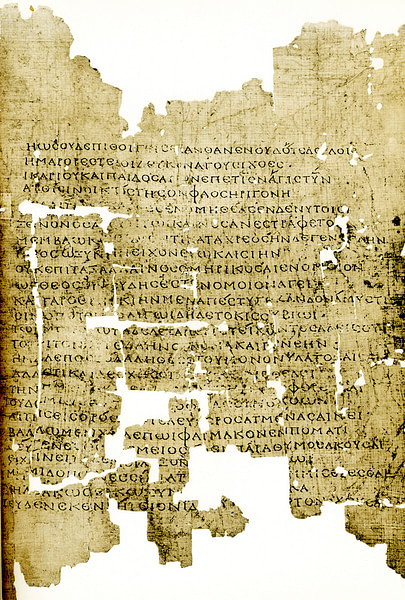
Aetia by Callimachus
His pupil Theocritus (315 – 250 BCE) originally from Syracuse likewise worked in the library at Alexandria, producing a number of works of which but 30 poems and 24 epigrams exist. He is said to be the originator of pastoral poetry. Like his teacher, his work influenced futurity Roman authors such as Ovid.
Apollonius Rhodius (born c. 295 BCE) was, similar the others, from Alexandria, serving as both a librarian and tutor. Historians are unsure of the origin of the "Rhodius" attached to his name; some presume he lived for a fourth dimension in Rhodes. His major work was the iv books of the Argonautica, a retelling of the story of Jason's travels to remember the fabled Golden Fleece. And, like Callimachus and Theocritus, his work influenced Catullus and Virgil.
Besides poetry and prose, the best-known playwright of the era, the Athenian Menander (342 – 290 BCE), must be mentioned. Menander was a student of philosophy and leading proponent of New Comedy, authoring over 100 plays, including Dyscolus, Perikeiromene, and Epitrepontes. He was the primary of suspense. His plays were subsequently adapted by the Roman authors Plautus and Terence.
The Hellenistic world produced a few notable historians, as well. Polybius (200 -118 BCE) was a Greek who wrote on Rome'due south rising to power. Denounced as too friendly to Rome, he was a proponent of Greek culture in Rome. Of his Histories, merely the first 5 books remain of the 40 written.
Lastly, Plutarch (born c. 45 BCE) was one of the near famous of the Greek historians. Originally from Chaeronea, he was a philosopher, teacher, and biographer. Although he spent time in Egypt and Rome (where he taught philosophy), he spent almost of his life in his home metropolis. Later in life, he served as a priest at the oracle at Delphi. His most famous work Parallel Lives provided biographies of Roman statesmen every bit well as such Greeks as Alexander, Lycurgus, Themistocles, and Pericles. Unlike other histories, he chose not to write a continuous history but concentrated on the personal character of each individual. He also wrote on ethical, religious, political, and literary topics of the twenty-four hours.
Legacy
After the death of Alexander the Great and the growth of Hellenistic culture across the Mediterranean, Roman literature and art had a distinctive Greek flavour. Greek literature had risen from the oral tradition of Homer and Hesiod through the plays of Sophocles and Aristophanes and now lay on the tables of Roman citizens and authors. This literature included the philosophy of Plato and Aristotle and the histories of Herodotus and Thucydides. Centuries of poetry and prose accept come up down through the generations, influencing the Romans as well as endless others across Europe. Referring to the "fire" of Greek poetry, Edith Hamilton wrote, "I might quote all the Greek poems in that location are, even when they are tragedies. Every one of them shows the fire of life called-for high. Never a Greek poet that did non warm both hands at that flame." (26) Today, libraries both public and private incorporate the works of those ancient Greeks. And, countless hereafter generations will exist able to read and enjoy the beauty of Greek literature.
This commodity has been reviewed for accuracy, reliability and adherence to bookish standards prior to publication.
What Are the First Ancient Greek Books I Should Read Anabasis
Source: https://www.worldhistory.org/Greek_Literature/
0 Response to "What Are the First Ancient Greek Books I Should Read Anabasis"
Post a Comment